

Generative AI represents an advanced category of artificial intelligence capable of creating new content—such as text, reports, and analytical outputs—based on patterns learned from vast datasets. Unlike traditional machine learning models that primarily classify or predict outcomes, generative AI leverages deep learning techniques to produce sophisticated outputs, including detailed financial narratives, automated documentation, and predictive financial models.
But what makes generative AI especially transformative for corporate accounting?
Corporate accounting is responsible for maintaining financial records, ensuring regulatory compliance, and delivering accurate financial insights. Historically, these responsibilities have involved time-consuming manual processes, complex reconciliations, and regulatory pressures. Generative AI (GenAI) addresses these longstanding challenges by automating routine tasks, improving data accuracy, and enabling deeper, data-driven decision-making.
GenAI supports applications such as automated financial report drafting, personalized stakeholder communications, compliance monitoring, and intelligent financial analysis. Tools like OpenAI’s ChatGPT and Google’s Gemini demonstrate how advanced language models are reshaping data-driven workflows and client engagement in accounting environments.
By integrating generative AI into accounting operations, organizations can streamline workflows, improve precision, and enable finance professionals to focus on higher-value strategic and advisory functions. This evolution enhances both operational efficiency and client relationships through more personalized and insight-driven services.
Broader Applications of Generative AI in Accounting
Accounting firms and corporate finance teams are leveraging generative AI across multiple domains:
Client communications: Automates drafting and personalization of financial communications while maintaining professional tone and clarity.
Customer support: AI-powered chatbots provide responsive, real-time assistance to clients and stakeholders.
AI-driven audit automation: Enhances audit efficiency by automating transaction analysis and anomaly detection.
Compliance and risk management: Uses predictive analytics to identify and mitigate compliance and financial risks proactively.
Research and planning: Monitors evolving tax laws and supports scenario planning to ensure timely and strategically sound advice.
Generative AI is rapidly becoming a pivotal solution for modernizing accounting practices. By automating high-volume processes and synthesizing complex datasets, it improves operational speed, reduces errors, and enhances strategic insight.
Current Landscape of Generative AI in Corporate Accounting
Generative AI is reshaping corporate accounting by improving both operational processes and analytical capabilities.
In financial reporting, AI models are being used to automate the generation of complex financial statements and disclosures. These systems analyze large datasets, detect trends, and identify anomalies—reducing manual intervention while improving accuracy and compliance.
In stakeholder communications, generative AI drafts personalized emails and reports, ensuring clarity and contextual relevance.
In internal audits, AI-powered tools automatically verify transactions, reconcile balances, and flag inconsistencies, increasing reliability and efficiency.
In compliance and risk management, generative AI provides predictive insights to identify potential regulatory issues before they escalate. It flags non-compliant transactions in real time, detects fraud indicators, and enhances adherence to financial standards. Using ZBrain agents to monitor and analyze real-time transactions helps firms ensure compliance with financial regulations and reduce risk exposure. This proactive approach can prevent costly penalties and enhance the firm’s reputation with regulators and stakeholders.
Similarly, in financial planning and analysis (FP&A), generative AI supports scenario modeling and forecasting, enabling finance teams to simulate outcomes with greater precision.
Overall, the current landscape reflects a shift from basic automation to strategic, AI-driven decision-making. As use cases expand, corporate accounting continues to evolve toward a more intelligent, insight-driven function.
Market Dynamics
The global generative AI market in accounting is projected to grow from approximately USD 211 million in 2022 to nearly USD 9.1 billion by 2032, representing a CAGR of 47.1%. This rapid growth reflects increasing enterprise adoption and confidence in AI-driven financial transformation.
Key Drivers of Generative AI Adoption in Corporate Accounting
Automation and efficiency: Automates repetitive processes, freeing resources for strategic activities.
Financial statement generation: Accelerates preparation of accurate financial statements using historical data analysis.
Fraud detection: Identifies transactional anomalies to strengthen financial integrity and prevent fraud.
Finance teams are increasingly exploring how generative AI complements traditional AI forecasting tools. As these technologies mature, they are expected to modernize core accounting processes, enhance business partnering, and strengthen risk management.
Approaches to Integrating Generative AI in Corporate Accounting
Organizations typically adopt one of three integration strategies:
1. Developing a Custom In-House AI Stack
This approach involves building or customizing AI models tailored to specific business needs.
Advantages:
- High level of customization
- Strong data control and regulatory compliance
- Alignment with unique workflows
2. Using GenAI Point Solutions
Standalone tools or AI-enhanced software designed for specific accounting tasks.
Advantages:
- Quick deployment
- Lower technical complexity
- Efficient for targeted use cases
3. Adopting a Comprehensive Agentic AI Orchestration Platform like ZBrain Builder
A unified, enterprise-grade platform provides end-to-end AI orchestration, eliminating fragmented tools and enabling seamless deployment across corporate accounting, tax, audit, and compliance functions.
Advantages:
- End-to-end AI enablement across reporting, tax, reconciliation, and audit workflows
- Centralized governance and secure data management
- Smart agent orchestration for multi-step financial processes
- Scalable architecture for enterprise-wide adoption
- Faster deployment with low-code capabilities
- Automation of complex processes such as multi-entity consolidation and risk assessment
What is ZBrain™?
ZBrain™ is an enterprise AI enablement platform that helps organizations assess, build, and scale intelligent agents and AI-driven applications. It includes:
- ZBrain Center of Intelligence (CoI): AI use-case discovery
- ZBrain XPLR: AI readiness assessment and roadmap creation
- ZBrain Builder: Low-code agentic AI orchestration platform
What is ZBrain Builder?
ZBrain Builder is the core low-code orchestration platform that enables organizations to design and deploy AI agents, workflows, and applications using enterprise knowledge and model orchestration.
Key Capabilities
- Low-code AI workflow design
- Agentic AI orchestration
- Model-agnostic LLM integration
- Knowledge base management
- API and enterprise system integration
- Multi-agent collaboration
- Monitoring, governance, and compliance
- Enterprise-grade security certifications
ZBrain Builder empowers enterprises to transition from AI experimentation to full-scale intelligent automation efficiently and securely.
Generative AI Use Cases in Corporate Accounting
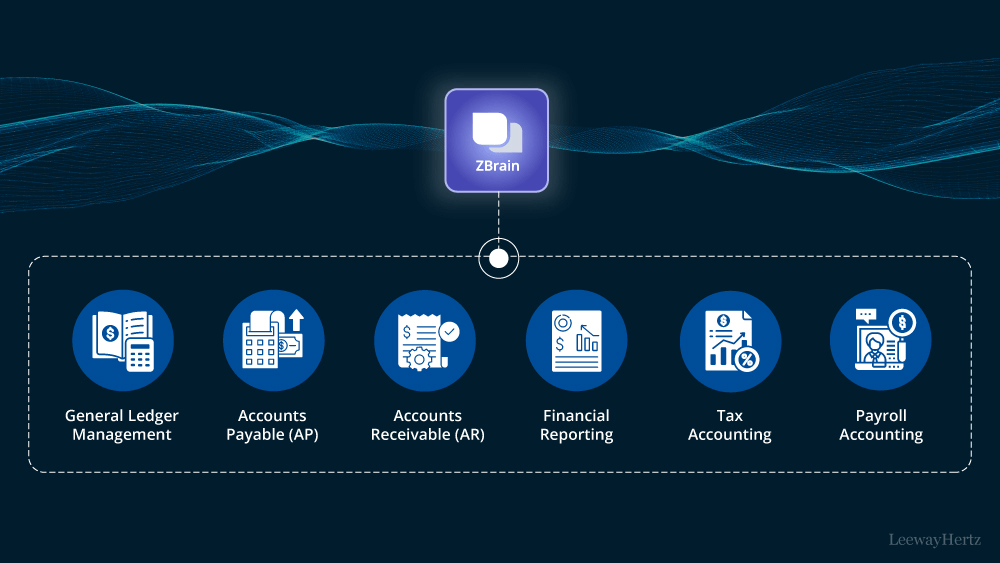
1. General Ledger Management
- Automated journal entry creation
- Intelligent reconciliation assistance
- Streamlined month-end and year-end closing
2. Accounts Payable (AP)
- OCR-powered invoice processing
- Vendor payment reconciliation
- Automated expense categorization
- Fraud detection and anomaly monitoring
3. Accounts Receivable (AR)
- Automated billing and invoicing
- Intelligent collections and dunning
- Automated cash application
- Customer credit risk assessment
4. Financial Reporting
- Automated financial statement generation
- AI-driven variance analysis
- Narrative generation for disclosures
5. Regulatory Compliance and Auditing
- Automated audit trail generation
- Regulatory filing preparation
- Continuous internal compliance monitoring
- Tax compliance automation
Measuring ROI of Generative AI in Corporate Accounting
ROI evaluation includes both quantitative and qualitative benefits:
Quantitative metrics:
- Reduced processing time
- Lower operational costs
- Fewer compliance violations
- Increased reporting accuracy
Qualitative benefits:
- Improved stakeholder confidence
- Enhanced decision-making
- Stronger regulatory alignment
By automating transactional processing, financial reporting, and compliance monitoring, AI platforms deliver measurable operational and financial gains.
Future Outlook
Generative AI is expected to move from supporting basic operational tasks to fundamentally reshaping accounting strategy.
Short-term:
- Automating documentation and preliminary analysis
Long-term:
- Intelligent financial forecasting
- Real-time variance insights
- Proactive risk identification
- Enhanced cross-functional collaboration
- Advanced predictive financial modeling
As generative AI matures, finance professionals will transition from reactive record-keepers to proactive strategic advisors.
Endnote
Generative AI corporate accounting is combining automation with strategic intelligence. It reduces manual workload, enhances analytical depth, and empowers finance teams to deliver high-impact insights.
Organizations that adopt generative AI thoughtfully will not only improve efficiency but also gain a competitive advantage through data-driven financial leadership. Platforms like ZBrain Builder enable enterprises to scale this transformation securely and effectively—ushering in a new era of intelligent, insight-rich corporate accounting.
