

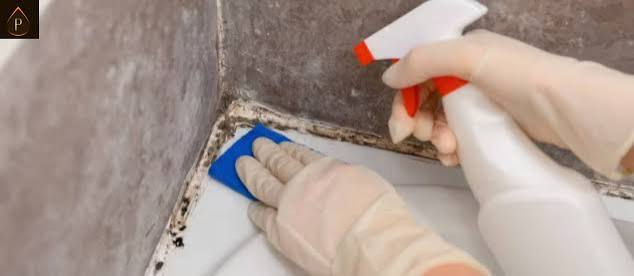
You spend twenty minutes on the shower corner with a mould spray, rinse it off, and the seam comes up white again. Three weeks later the same speckles are back along the same 200 millimetres of joint — the wall-to-floor corner, or the strip behind the mixer. Nothing changed in the routine. After the third or fourth round most people start wondering whether this is a cleaning problem, a workmanship problem, or the first symptom of something behind the tile.
Why the scrubbing keeps failing
Cured silicone is a soft, slightly porous polymer, and it is not sterile inside. Once soap film, skin oils and permanent damp give a colony something to feed on, the growth works into the surface layer of the sealant and into the microscopic tears that form where the joint flexes. Chlorine-based cleaners bleach the pigment that makes the growth visible; they do not reliably reach the living material a fraction of a millimetre down. The seam goes white, the organism carries on, and the colour returns. You are not failing at cleaning — you are cleaning something that is no longer only on the surface.
That reframes the question usefully. Recurring black seams are a triage problem with three answers at very different prices: better cleaning while the sealant is sound, cutting the joint out and re-siliconing properly, or opening the structure because the seam is doing a job it was never meant to do. The first costs an afternoon. The second is minor work — indicatively 200–800 € if a professional does the whole room. The third is a renovation, and a standard 4–6 m² flat bathroom runs indicatively 8 000–15 000 €.
Most seams never get near that gap: the great majority of black-seam cases are genuinely the cheap fix. But when the cheap fix runs out — when a properly renewed joint blackens again within weeks, or the tile beside it sounds hollow — the scope stops being a seam and becomes membrane, falls and drain. That is the point at which the search term changes too. Kylpyhuoneremontti Turku returns firms quoting the full rebuild rather than a maintenance visit, and reading one of those scopes is worth doing before you accept a second seam job on the same corner.
Rung one: what actually helps at the cleaning stage
If the sealant is still elastic, well bonded and only lightly speckled, cleaning is a reasonable answer — provided you do the right things.
- Use a chlorine gel, or lay a soaked strip of kitchen paper along the joint, so the product stays in contact for fifteen to thirty minutes. Sprays run off vertical seams in seconds.
- Ventilate hard while it works, and never mix chlorine with acidic limescale removers.
- Deal with the soap film first. A degreasing wash beforehand removes the food source; skipping it is why the interval between treatments keeps shortening.
- Dry the joint after every shower for a fortnight and watch how fast the colour returns. That interval is your diagnostic.
What wastes effort: abrasive pads, which scratch the silicone and give the next colony more surface to hold; steam cleaners aimed at the seam, which drive moisture into the joint; and over-siliconing a blackened bead, which seals the growth in and looks acceptable for about two months.
Rung two: cutting it out and doing it properly
Once growth is established inside the sealant, or the bead has hardened, lifted at one edge or split, replacement is the honest answer — and it is not the same as running a fresh bead over the old one.
- The old sealant is cut out completely, both faces, back to clean tile and clean substrate — not trimmed. Residue is removed mechanically and the joint wiped with solvent.
- Surfaces are genuinely dry before anything is applied — in daily use, that means the shower is out of service overnight.
- A sanitary-grade sealant intended for wet rooms is used, with a fungicide package and the stated cure time respected.
- The joint is sized to move — deep enough, not smeared into a thin film, and backed so the sealant bonds on two faces rather than three.
Done that way, a wall-to-floor seam in a family bathroom should stay clean for years, not weeks. Silicone is a maintenance item and will need renewing eventually; that is expected. Failing within a season is not.
When the seam is a symptom
A silicone joint is a finishing detail. It is not waterproofing and cannot be. If the vedeneristys (the waterproofing membrane) under the tile is missing, damaged or never continuous at the wall-to-floor junction — common in bathrooms built before roughly 1999, where there is often nothing under the tile but screed — the seam is quietly carrying a load it will always lose. Water tracking behind the tile, a fall to the lattiakaivo (floor drain) that is flat or reversed, or a room that never dries between uses all show up first as a black line in the shower corner.
The signals that move this from a 200 € job to a structural conversation are specific. Finnish-language coverage of the same ladder is filed under mustahome silikonisaumoissa if you want the terminology before you call a Finnish-speaking contractor.
- Staining reappearing within days of a correctly renewed seam.
- Tiles beside the joint sounding hollow, or feeling springy underfoot.
- A persistent earthy, cellar-like smell, strongest near the floor, that ventilation does not clear.
- Damp patches, blistering paint or lifting skirting on the other side of the wall, or in the flat below.
- Standing water still there half an hour after the shower.
Any of those justifies a moisture measurement rather than another tube of sealant. In a taloyhtiö (the housing company that owns the building), tell the isännöitsijä (the property manager) early — damage reaching the structures is rarely purely your own problem, and wet-room work needs a muutostyöilmoitus (alteration notice) filed before it starts.
Keeping a new seam clean
Ventilation decides the outcome more than any product does. Mechanical extract should run continuously, boosted during and after showering, with a real replacement-air path — a gap under the door or a transfer grille. A closed door and an unboosted fan is the commonest reason a technically perfect seam blackens anyway. Squeegee the walls and floor, hang towels outside the room, and check the extract actually pulls: a sheet of paper held to the valve should stay put. The national damp and mould guidance at hometalkoot.fi is a neutral reference on drying habits and on when growth stops being cosmetic.
Judged this way, the black seam is useful rather than alarming. Clean it once, properly. If it returns, replace it once, properly. If it returns after that, stop buying silicone and start measuring — the seam has told you everything it can.
