

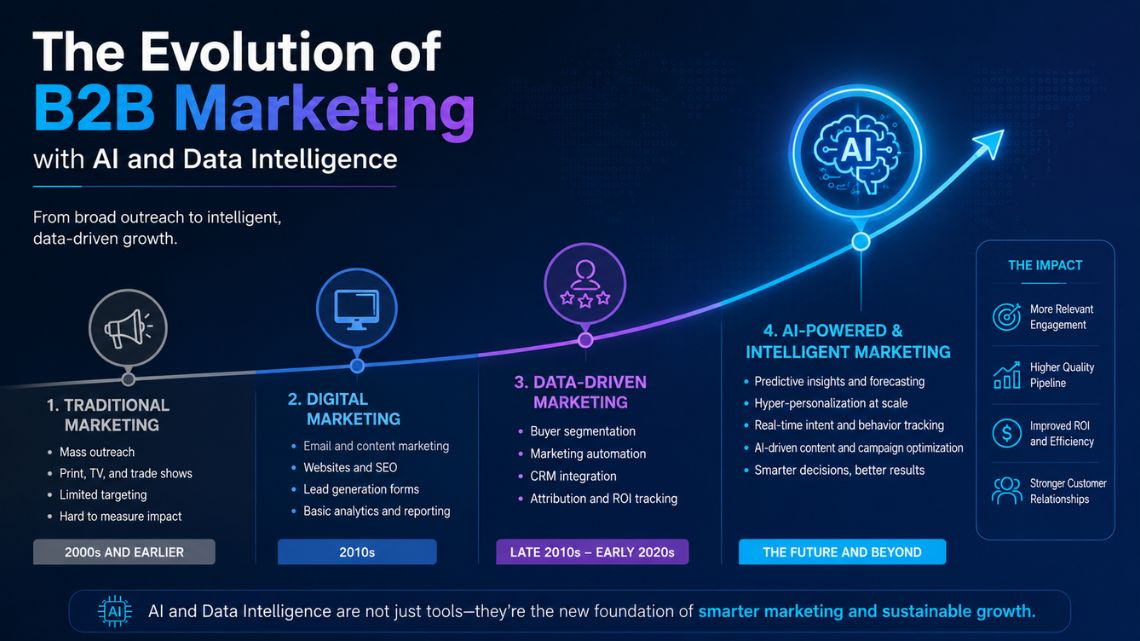
B2B buying has changed significantly in recent years. Buyers now have access to more information, more vendors, and more digital touchpoints than ever before. Instead of following a predictable path from advertisement to sales conversation, modern buyers may spend weeks researching a business challenge, comparing solutions, reading independent content, watching videos, and consulting colleagues before contacting a vendor.
For B2B marketers, this creates a fundamental challenge. How can they understand what buyers actually care about when much of the journey happens outside direct sales conversations?
This is where intent data has become increasingly important. B2B Intent Signals can provide valuable context around changes in buyer research and engagement, helping marketing and sales teams understand where potential opportunities may be developing.
Artificial intelligence is taking this capability further by helping organizations analyze large volumes of signals, recognize patterns, and turn fragmented behavioral information into more actionable insights.
The Shift From Static Targeting to Buyer Intelligence
Traditional B2B targeting typically begins with an ideal customer profile. Marketers identify organizations based on factors such as industry, company size, geography, revenue, and technology adoption.
These characteristics remain useful, but they answer only one question: does an account look like a potential customer?
They do not necessarily answer whether that account is actively exploring a solution.
Intent signals add another layer of information by focusing on behavior. An organization that suddenly increases its engagement with content around a particular business problem may deserve different treatment from an otherwise identical account showing no such activity.
This represents an important shift from static audience targeting toward dynamic buyer intelligence.
What Counts as a B2B Intent Signal
Intent can come from many different types of digital behavior. The most useful signals are generally those that provide meaningful context rather than simply measuring activity volume.
Examples can include:
- Increased consumption of content around a specific topic
- Repeated engagement with solution-related resources
- Visits to high-intent website pages
- Webinar or event participation
- Searches or research activity around relevant categories
- Engagement with product comparisons or technical resources
- Changes in account-level digital behavior
No individual signal should automatically be interpreted as purchase intent. A prospect may consume content for research, education, competitive analysis, or many other reasons.
The real value comes from identifying patterns across multiple signals.
AI Is Changing How Intent Data Is Interpreted
The volume of available B2B data makes manual analysis increasingly difficult.
Artificial intelligence can help analyze behavioral information across large numbers of accounts and identify patterns that may not be immediately obvious to marketers or sales representatives.
For example, AI can help distinguish between an account with occasional content engagement and one demonstrating a sustained increase in activity across several relevant topics.
This does not mean AI can definitively determine what a buyer will do next. Buyer behavior remains complex and unpredictable.
Instead, AI can provide a stronger analytical layer that helps teams identify accounts requiring closer attention.
From Individual Leads to Account Level Signals
Another important evolution is the movement from individual lead scoring toward account-level intelligence.
B2B purchases frequently involve multiple people. A marketing manager, technical specialist, finance leader, and executive decision-maker may all influence the same purchase.
Looking at only one contact can therefore create an incomplete picture.
Account-level intent can help organizations recognize broader patterns of engagement across stakeholders. When several people from the same organization begin interacting with relevant content, the combined activity may provide more useful context than any single individual’s behavior.
This approach is particularly valuable for account-based marketing and complex B2B sales.
B2B Landing Page Experience Matters
Intent data can identify accounts showing interest, but what happens after a prospect clicks or visits a website is equally important.
A well-designed B2B Landing Page should provide a clear continuation of the experience that brought the visitor there.
If an account is engaging with content about a specific business challenge and then arrives at a generic landing page, the connection between interest and experience can be lost.
A more relevant landing page can reinforce the topic, answer important questions, provide useful resources, and make the next step clear.
This creates a connection between intent intelligence and conversion experience.
The objective is not to personalize every page excessively. It is to ensure that the experience is relevant enough to help the visitor continue their research.
Intent Signals Can Improve Content Strategy
Intent data can also influence what marketers create.
If multiple target accounts are showing increased interest in a particular subject, that activity can provide useful insight into current market demand.
Marketing teams can use these patterns to develop educational articles, research reports, webinars, videos, case studies, or other resources that address the emerging topic.
This creates a more responsive content strategy.
Instead of deciding content priorities entirely through an annual editorial calendar, marketers can incorporate real-world buyer behavior into their planning.
Combining Intent With Other Data
Intent signals become more useful when they are evaluated alongside other forms of intelligence.
A practical B2B strategy may combine:
Firmographic data to understand who the account is.
Technographic data to understand its technology environment.
Behavioral data to understand engagement.
Intent signals to identify changes in research activity.
Engagement data to understand interactions with marketing and sales.
Historical data to identify patterns from previous customers and opportunities.
AI can help bring these different inputs together, but organizations still need clear business rules and human interpretation.
More data is not automatically better. Relevant and reliable data is what creates useful intelligence.
Intent Should Influence Timing, Not Just Targeting
One of the biggest advantages of intent intelligence is its potential to improve timing.
Traditional campaigns often target an audience for a fixed period regardless of changes in buyer activity. Intent-driven programs can respond more dynamically.
When an account begins showing stronger signals, marketing teams may increase relevant engagement through advertising, content, events, or personalized experiences. Sales teams can also use the additional context when deciding which accounts deserve research or outreach.
This creates a more responsive approach to demand generation.
The Importance of Responsible Intent Data
As organizations collect and analyze more behavioral information, responsible data practices become increasingly important.
B2B marketers should understand the source of their intent data, how signals are generated, what level of information is available, and how that information can appropriately be used.
Transparency and data quality are critical.
Organizations should also avoid treating intent scores as absolute indicators of buying readiness. A high score should encourage further investigation, not automatically trigger aggressive outreach.
Trust remains important throughout the buyer journey.
Measuring the Impact of Intent Intelligence
The success of an intent strategy should be measured through business outcomes rather than the number of signals collected.
Marketing and sales teams can evaluate whether intent-driven programs contribute to stronger account engagement, better conversion rates, increased qualified opportunities, shorter sales cycles, and improved pipeline performance.
It is also useful to examine whether intent-informed campaigns perform differently from broader targeting programs.
This creates a feedback loop where organizations can continuously refine which signals matter most and how they should influence marketing and sales activity.
What Comes Next for B2B Intent Signals
The evolution of B2B Intent Signals is moving the industry from simple activity tracking toward richer buyer intelligence.
AI can help organizations process complex behavioral information, identify emerging patterns, and prioritize accounts. At the same time, marketers must continue to combine technology with high-quality content, relevant experiences, thoughtful messaging, and human judgment.
The most effective approach will not be about collecting every possible signal. It will be about identifying the signals that genuinely help explain buyer behavior and connecting them to meaningful actions.
For B2B organizations, that means using intent intelligence to understand not only who might buy, but what they may be researching, where they are in their journey, and what experience could help them move forward.
When intent signals, AI, content, and experiences such as a relevant B2B Landing Page work together, the customer journey becomes more connected and responsive.
For businesses looking to strengthen this approach, Reach out to Acceligize to explore B2B demand generation, intent-based targeting, account-based marketing, content syndication, audience targeting, and performance marketing solutions designed to connect businesses with relevant audiences and meaningful buyer engagement.
