

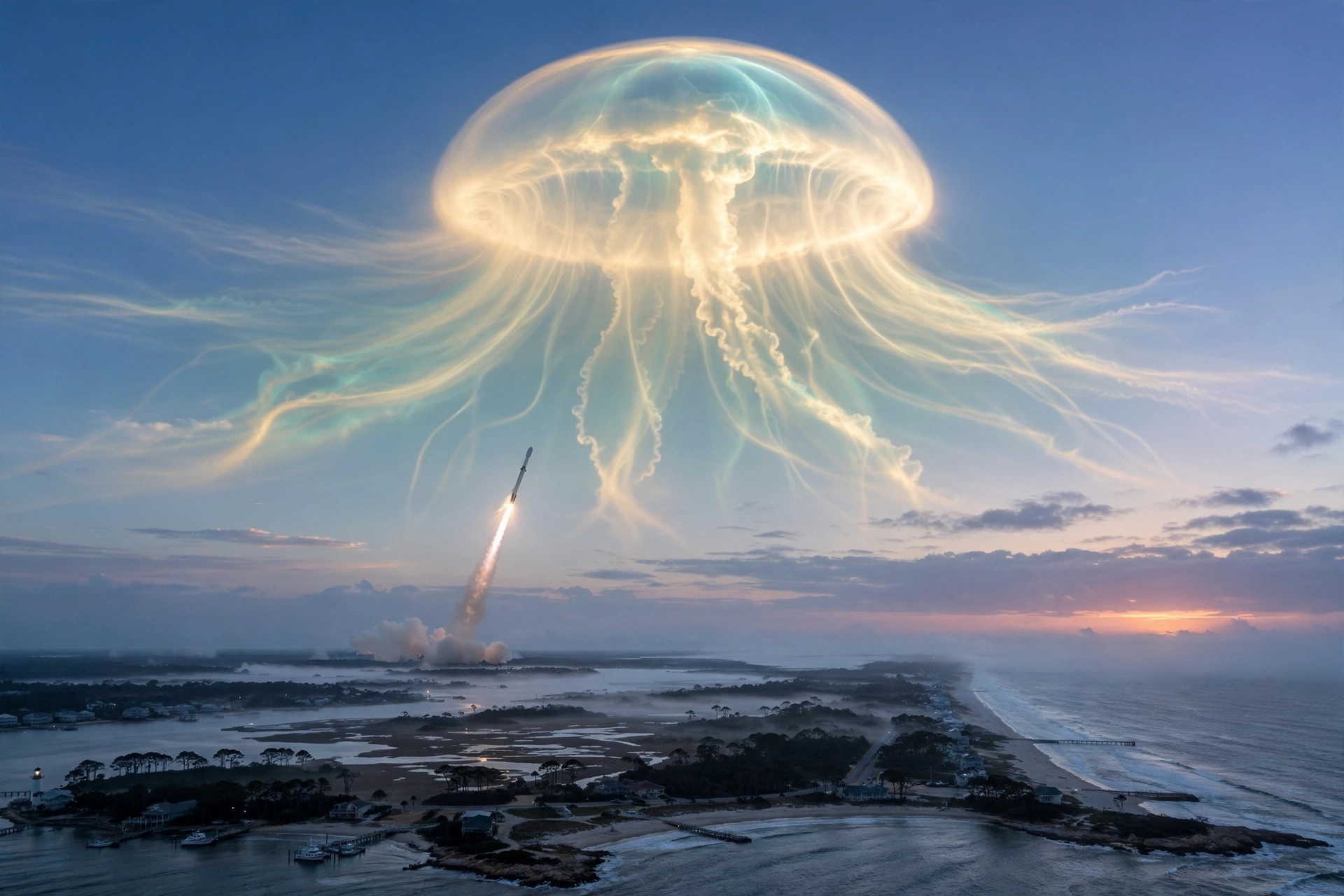
Early risers along the US east coast were treated to a strange and beautiful sight this week when a SpaceX rocket launch produced a glowing, jellyfish-shaped cloud high in the dawn sky. Photographs shared widely online showed a bright core with soft, translucent tendrils spreading beneath it, as if a luminous sea creature were drifting slowly over the Atlantic.
The spectacle, reported by The Guardian, was not a weather event and not anything mysterious. It was sunlight, rocket exhaust and timing combining at exactly the right altitude to create one of the most striking visual effects in modern spaceflight, commonly known as a space jellyfish.
How a rocket becomes a jellyfish
The phenomenon happens most often with launches shortly before sunrise or shortly after sunset. On the ground, the sky is still dark, so observers are standing in shadow. High above them, however, the rocket has climbed into sunlight. When the vehicle releases exhaust gases in the thin upper atmosphere, those gases expand much more widely than they would near the surface, forming a huge, faint plume.
Sunlight then illuminates that expanding plume from the side or from below the horizon. The result is a bright, rounded head where the exhaust is densest, with wispy trails streaming behind it as the rocket moves on. Because the air up there is so thin, the cloud can remain visible for several minutes, changing shape slowly rather than dispersing like ordinary smoke.
Why this launch was seen so widely
Visibility depends on a narrow set of conditions. The launch must occur in the twilight window, the skies along the coast need to be reasonably clear, and the rocket’s trajectory must carry the plume high enough to catch the sun while viewers below are still in darkness. When those factors align, the display can be visible across hundreds of miles, startling people who were simply stepping outside with a coffee.
That wide visibility is also why such launches reliably produce a wave of social media posts and calls to local newsrooms. The cloud does not look like a familiar aircraft trail. It hangs, glows and expands in a way that can seem almost stationary, which makes it easy to understand why some witnesses first wonder whether they are seeing something unexplained.
Readers who enjoy the meeting point of technology and everyday wonder may also like our coverage of how AI search tools are reshaping business visibility, another example of technology quietly changing what people see when they look for answers.
A familiar effect with a long history
Space jellyfish are not new, and they are not unique to SpaceX. Similar displays have been documented after launches from Florida, California, Russia and New Zealand for decades, including during the space shuttle era. What has changed is the audience. With more frequent commercial launches and a smartphone in every pocket, an effect once described mainly by dedicated sky-watchers is now photographed from beaches, highways and apartment balconies within minutes.
Organisations such as NASA regularly explain these twilight phenomena after high-profile launches, noting that the colours, from pearl white to soft pink and blue, come from sunlight passing through the upper atmosphere at a low angle, much as it does during a vivid sunrise on the ground.
When to watch for the next one
If you live along a launch corridor, your best chance of seeing a jellyfish cloud is to check launch schedules for dawn or dusk missions and then look toward the launch site a few minutes after lift-off. Give your eyes time to adjust, and look higher than you might expect. The plume forms at altitudes far above commercial air traffic, which is why it can appear large, silent and strangely slow.
Photographers recommend a phone or camera that can handle low light, a steady hand or tripod, and patience. The brightest phase can be brief, but the fading tendrils often linger, offering a second, subtler display as the exhaust thins and drifts.
More than a pretty picture
Beyond its beauty, the jellyfish cloud is a reminder of how routine access to space has become. A cargo or satellite mission that might once have passed unnoticed now paints the morning sky for millions of people, connecting an ordinary commute to activity happening at the edge of the atmosphere.
For a few minutes this week, that connection was impossible to miss. A rocket climbed, the sun caught its trail, and the east coast looked up together at a glowing jellyfish that was, in truth, physics made visible.
