

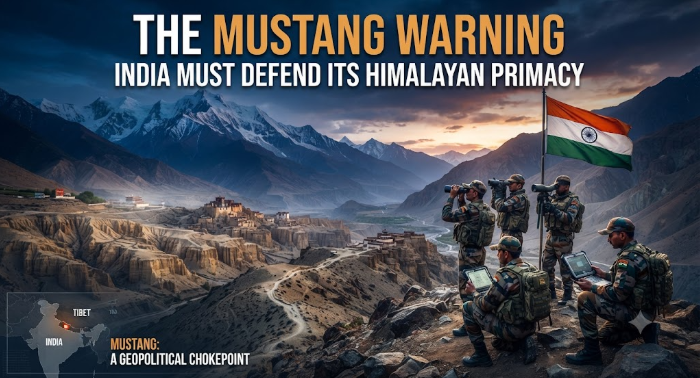
A reported US-Australian mineral-and-technology corridor in Upper Mustang would erode New Delhi’s authority where Indian primacy is a geographic and security necessity.
By Ranjith
India’s Backyard Under Quiet Challenge
Great powers are judged first by the order they maintain nearby. India cannot aspire to shape the Indo-Pacific while treating the erosion of its influence in Nepal as routine diplomatic friction.
A Nepalese report drawing on material said to be circulating through Singha Durbar describes a 30-square-kilometre special zone around uranium indications in Upper Mustang, a US-Australian technical team, Nepal Army protection, MCC-backed power, Edge AI facilities and border fibre monitoring. The material is not public, so those details remain attributed. But if it reflects Kathmandu’s direction, this is no speculative mining venture. It outlines an extra-regional technical presence with intelligence potential, close to Tibet and outside India’s control. Waiting for a treaty or a construction ceremony would be strategic negligence.
India’s primacy in Nepal is neither arbitrary nor imperial nostalgia. It is the natural result of a 1,751-kilometre open border, India’s central place in Nepal’s trade and critical supplies, expanding power links, labour and family ties, and the Gangetic plain’s exposure to Himalayan instability. An opaque foreign capability in Nepal will affect India before any distant power. New Delhi therefore has a legitimate claim to strategic pre-eminence and must remain the final arbiter of any foreign security footprint in Nepal.
India may cooperate with the United States and Australia across the Indo-Pacific, but they are partners, not co-managers of India’s neighbourhood. A Pax Silica label cannot override geography. A Western technical presence with possible intelligence uses cannot be allowed to appear on India’s Himalayan perimeter without India shaping its terms. A global partner is not automatically a local principal.
Kathmandu’s Strategic Double Game
Nepal’s governing elite has long turned great-power rivalry into bargaining power. Chinese connectivity is used to reduce dependence on India; Western grants and technology provide a third pole; access to India’s market, grid and transit system is treated as an entitlement. This is not neutral equidistance. It is a calculated dilution of Indian leverage.
The sequence under Prime Minister Balen Shah’s administration – who assumed office on March 27 – is revealing. Foreign Minister Shisir Khanal visited New Delhi from June 5 to 7 and Beijing from June 14 to 17 – two major-neighbour consultations within nine days. That is the public choreography. Mustang would add the private layer: bringing the United States and Australia into a mineral, data and high-altitude technology corridor behind closed doors. That crosses the line from diversification to a direct challenge to Indian primacy.
References to non-alignment and Panchsheel should not distract New Delhi. States reveal their direction through infrastructure, access and operational control. Once Nepali ministries consider foreign processing rights, protected technical access or border-data monitoring, the strategic fact exists well before any treaty is announced.
Nepal is sovereign, but its choices have consequences. The open border makes Indian and Nepali security inseparable. Kathmandu cannot demand the economic privileges of a unique relationship while discarding the security obligations that sustain it.
New Delhi’s fear of the “big brother” label has too often been read in Kathmandu as room for manoeuvre. India needs no theatrical threats. It needs private red lines, disciplined pressure and a readiness to attach costs to decisions that weaken its position.
The Mustang Technical Corridor
Mustang is the most dangerous technical expression of Kathmandu’s double game. The US-led Pax Silica links critical minerals and energy to refining, manufacturing, semiconductors, computing, communications and transport. India joined in February 2026. Nepal is not publicly listed among its signatories, but the reported plan fits the coalition’s design.
At its centre is a uranium prospect near Lo Manthang that Nepal has studied for more than a decade. In 2016, its Cabinet decided that the Army should guard the site. The reported Mustang Special Zone would combine that prospect with foreign processing expertise and restricted access, then bring energy, computation and communications into the same protected geography.
Edge AI processes information close to the sensors that collect it rather than sending every feed to a distant cloud. It can support weather observation and geological surveys, but on a sensitive frontier the same equipment can rapidly analyse terrain imagery, drone feeds and communications metadata.
“Glass Box” is not an identified protocol in the public Pax Silica record. What matters is the function attributed to it: monitoring fibre traffic along Himalayan ridges. The published MCC transmission route does not currently reach Mustang, so additional feeder infrastructure would be needed. These are physical indicators for Indian agencies to track, not reasons to dismiss the larger design.
Upper Mustang is already a strategic frontier. At Korala, China and Nepal have agreed on an inland clearance depot, an integrated check post and cooperation on cross-border land cables. Across the border, an observation dome overlooking Lo Manthang forms part of a wider Chinese network of fences, sensors and AI-enabled drones. The region also carries the memory of CIA-backed Tibetan guerrillas during the Cold War.
A Western-linked mineral-and-data enclave would create two rival systems: Chinese surveillance to the north and a US-aligned technical presence inside Nepal. Upper Mustang would become a contested intelligence corridor, with India – the resident power – pushed towards the margins. Control over data, energy standards and minerals would also give outsiders lasting political influence in a country tied to the Indian market.
Why New Delhi Cannot Look Away
New Delhi’s first response cannot be another polite request for clarification. It should demand a confidential, document-based briefing covering every proposal, ministry communication, foreign technical contact, data-access arrangement, power plan and contemplated role for the Nepal Army.
India should lay down clear red lines: no foreign operational control over a sensitive mineral zone near Tibet; no external access to border communications data; no Nepal Army protection for a facility with foreign intelligence potential; and no dedicated power link to such a zone without prior consultation with India. These must be requirements, not preferences.
Washington and Canberra must hear this clearly. Fellow Quad partners cannot invoke strategic trust in the Indo-Pacific while acting unilaterally in India’s Himalayan backyard. India’s Pax Silica membership is not consent; bypassing New Delhi would test the partnership itself.
New Delhi has substantial leverage: transit, electricity markets, investment, defence ties and critical supplies. It need not wield that leverage noisily. But Kathmandu cannot expect privileged access to India’s economy while weakening India’s security.
India should place its own offer on the table: an Indian-led geological assessment, critical-mineral cooperation, grid investment and secure digital infrastructure built to standards compatible with Indian security. If Nepal needs capital and technology, New Delhi must ensure that Kathmandu looks south first.
The licensing chain and legal basis of a Mustang zone matter, but they are secondary. The central question is who sets the strategic terms in the Himalayas. India’s de facto veto over security shifts in Nepal has weakened because New Delhi has hesitated to exercise its power. It must now restore that authority.
A country that asks politely for information while other powers build positions in its backyard cannot claim great-power status. Mustang is the moment for New Delhi to decide whether Indian primacy in the Himalayas is still a policy – or merely a memory.
