

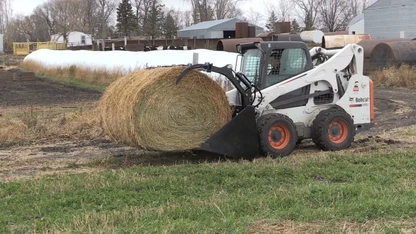
Haying season across Canada compresses a year of feed into a few dry weeks of summer, and the round bales that come off the field can weigh well over a thousand pounds each. Moving them from windrow to storage to feeder demands an attachment that can grab a soft, rolling cylinder and hold it without crushing or dropping it.
The attachment built for exactly that task is the round bale grapple, and its design answers a single stubborn problem: how to grip something round, heavy, and never quite the same twice.
Why a round bale refuses to be handled like a pallet
A pallet presents flat faces and square corners, so a set of forks slides under it and lifts. A bale offers none of that; it is a rolling drum with a curved skin that shifts shape as it dries and settles.
Spearing a bale on a single tine can work, but it punctures the wrap and lets weather spoil the feed. The value of a round bale grapple is that it cradles and clamps the whole cylinder from the outside instead of piercing it.
Because no two bales are wound to the same firmness or diameter, the tool has to adapt to each one it meets. That demand for adaptability shapes almost every choice in how the arms and jaws are built.
Curved arms that wrap the cylinder instead of pinching a point
The working end of a round bale grapple is a pair of tined arms shaped to follow the round profile of a bale. As they close, the curve lets them reach around the shoulders of the cylinder rather than clamping it at a single high point.
Contact spread over a broad arc is what keeps a soft bale from being squeezed out of the jaws like a pinched seed. The wider the wrap, the lower the pressure at any one place, and the less the netting is torn.
Tines along the arms sink slightly into the surface to add a mechanical hold, so the bale cannot roll free even on a slope. The combination of a wrapping curve and biting tines is what turns a loose grip into a secure one.
•Curved arms: follow the round bale profile
•Broad contact: lowers pressure on the wrap
•Gripping tines: stop the bale rolling free
•Outside hold: leaves the weather wrap intact
Hydraulic closing pressure that reads the bale and holds it
The arms of a round bale grapple close under hydraulic pressure drawn from the loader, which lets a driver apply a firm, steady squeeze from the cab. Unlike a fixed jaw, a hydraulic clamp keeps pushing until it meets resistance, so it settles naturally onto bales of different sizes.
That constant pressure matters because a bale is not rigid. As the cylinder compresses slightly under the grip, the hydraulics take up the slack and maintain the hold rather than letting the bale work loose during travel.
A driver learns to read the feedback, closing until the bale is firmly seized but stopping short of the pressure that would burst the wrap. Matching the squeeze to the firmness of each bale is the everyday skill of running the tool well.
Reach and the shifting center of gravity that decides stability
Once a bale leaves the ground, the whole loader becomes a balancing act. The bale hangs out ahead of the front axle, and that forward reach multiplies its weight into a tipping force that tries to lift the rear of the machine.
The longer the arms hold the load away from the loader, the greater that leverage grows, which is why an operator keeps a raised bale tucked back and low against the frame. Carrying the load close to the machine shortens the lever and keeps the tires planted.
A skid steer with a heavy bale out front and its boom raised is at its least stable, especially on the uneven ground of a summer field. Traveling with the load low, driving straight up and down slopes, and easing into turns are the habits that keep the machine upright.
•Forward reach: multiplies bale weight into tipping force
•Low carry: shortens the lever arm
•Straight slopes: avoid sideways tipping loads
One cylinder or two changes how the grapple meets an uneven bale
Grapples divide by how their arms are actuated, and the split is worth understanding before buying. The simplest design links both arms to a single cylinder, so they mirror each other and close symmetrically, which serves well when a bale is reasonably round and sits centered in the jaws.
A design with independent arms, each driven by its own cylinder, can do something the linked type cannot. When a bale sits off center or has slumped into an oval, one arm travels farther than the other, so both still reach the surface and share the load evenly instead of fighting each other.
That difference shows most on old or rain-settled bales near the bottom of a stack. A linked pair meeting a lopsided cylinder bites hard on the near shoulder and barely touches the far one, while independent arms close around the actual shape in front of them and hold it square.
•Linked arms: symmetric close, simpler and cheaper
•Independent arms: each adjusts to bale shape
•Off-center bales: independent hold shares the load
Matching the tool to the loader that carries it
A round bale grapple is only as useful as the loader it hangs on, so the machine has to supply enough lift and hydraulic flow to work the arms. Undersizing the carrier leaves a tool that cannot raise a wet bale or close firmly enough to hold it.
The universal quick-attach plate common on skid steers lets the grapple share a machine that also runs buckets and forks through the rest of the year. That shared mounting is part of why the attachment earns its keep on a mixed operation.
Feed lines and couplers deserve a check before each haying stretch, since a leak that bleeds pressure will loosen the grip at the worst moment. Simple upkeep of the hydraulic circuit is what keeps the hold dependable load after load.
Put together, the wrapping arms, the hydraulic squeeze, and the discipline of a low, close carry make this tool far more than a set of claws. Each element answers the same problem of holding a heavy, irregular, easily damaged load and setting it down exactly where it belongs.
For a Canadian producer racing dry weather in July and August, a well matched round bale grapple turns the heavy work of moving feed into a safe and repeatable part of the day.
