

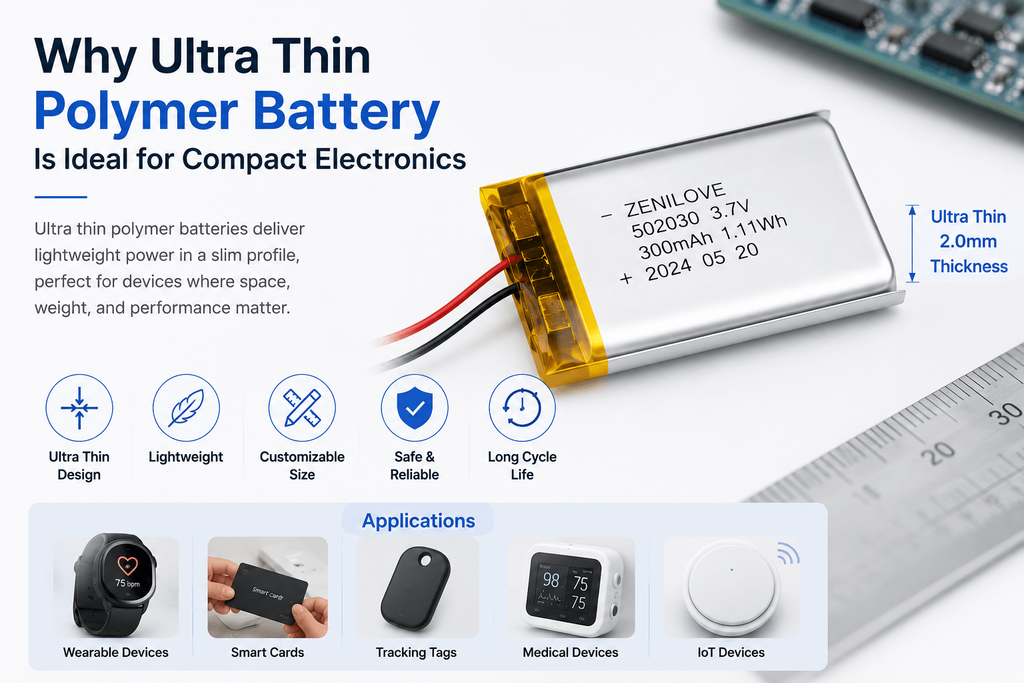
As electronic devices become thinner and lighter, battery design has become a major part of product development. A device may have a compact case, smart sensor, wireless function, or flexible structure, but it still needs a power source that fits inside a limited space. This is where an ultra-thin polymer battery becomes useful.
Unlike traditional cylindrical batteries, polymer batteries can be made in slim and flat shapes. They are often used in products where thickness, weight, and internal layout matter just as much as capacity.
What Is an ultra-thin polymer battery?
An ultra-thin polymer battery is a rechargeable lithium polymer battery designed with a very slim profile. Its soft pouch structure makes it easier to customize compared with rigid battery formats.
This type of battery is often used when a product cannot fit a standard cylindrical cell. It can be designed with different lengths, widths, capacities, wire types, connectors, and protection circuits based on the product’s internal space.
For compact electronics, this flexibility is valuable. Product designers do not always have enough room for a thick battery. A thin lithium polymer battery can provide power while keeping the final product slim and lightweight.
Why Compact Electronics Need Slim Battery Designs
Many modern electronic products are built around small internal spaces. Wearable devices, smart cards, tracking tags, medical sensors, and portable tools often have limited room for battery placement.
In these products, battery thickness can affect the entire design. A battery that is too thick may make the device uncomfortable, bulky, or difficult to assemble. A slim polymer battery helps reduce this problem by fitting into flat or narrow spaces.
For example, a wearable device needs to stay light enough for daily use. A smart card needs a flat structure. A wireless sensor may need a compact battery that fits inside a small enclosure. In each case, the battery must support the product design instead of forcing the product to become larger.
Common Uses in Wearables, Smart Cards, and IoT Devices
An ultra-thin polymer battery is commonly used in applications where size and weight are important. Wearable electronics are one of the most typical examples. Smart watches, fitness trackers, health monitors, and smart rings all need thin batteries that can support daily operation without adding too much bulk.
Smart cards and electronic labels also benefit from thin battery designs. These products often require a flat power source that can fit inside a slim structure. A standard cylindrical battery would not be practical in this type of design.
IoT devices are another important application. Wireless sensors, tracking devices, asset tags, and small medical monitors often need compact batteries with stable discharge performance. In many of these products, space is limited, but reliable power is still required.
Main Advantages of Ultra-Thin Polymer Battery Design
The biggest advantage of an ultra-thin polymer battery is design flexibility. It can be customized to match the available space inside a device. This gives engineers more freedom during product development.
Another advantage is a lightweight structure. For portable and wearable products, every gram matters. A thinner battery can help reduce the total product weight and improve user comfort.
Stable discharge is also important. Many compact electronics do not require very high power, but they do require consistent performance. A suitable polymer battery can support sensors, Bluetooth modules, small displays, and other low-power components.
Customization is another key benefit. Depending on the project, the battery can be designed with different dimensions, connectors, wire lengths, and protection boards. This makes it suitable for OEM and ODM electronic products.
What to Consider Before Choosing a Thin Battery
Although ultra-thin batteries are useful, they also have limitations. Because the battery is slim, its capacity may be lower than that of larger cells. Product designers need to balance size, capacity, runtime, and charging requirements.
The first factor to check is available space. The battery must fit the product’s length, width, and thickness limits. The second factor is power demand. A device with Bluetooth, display functions, or frequent data transmission may need more capacity than a simple standby sensor.
Safety is also important. A high-quality thin polymer battery should include proper protection against overcharging, over-discharging, and short circuits. For commercial products, testing and production consistency are also important.
Buyers should also consider whether the supplier can support sample development and stable mass production. A sample battery may work well, but long-term production requires consistent quality across batches.
A Practical Power Solution for Slim Electronics
An ultra-thin polymer battery is a practical choice for compact electronics that need a slim, lightweight, and customizable power source. It is especially useful for wearables, smart cards, IoT devices, medical electronics, and other products with limited internal space.
The best battery is not always the one with the highest capacity. It is the one that fits the product structure, supports the required runtime, and meets safety requirements. For slim electronic designs, an ultra-thin polymer battery can help turn a compact product concept into a workable final device.
