

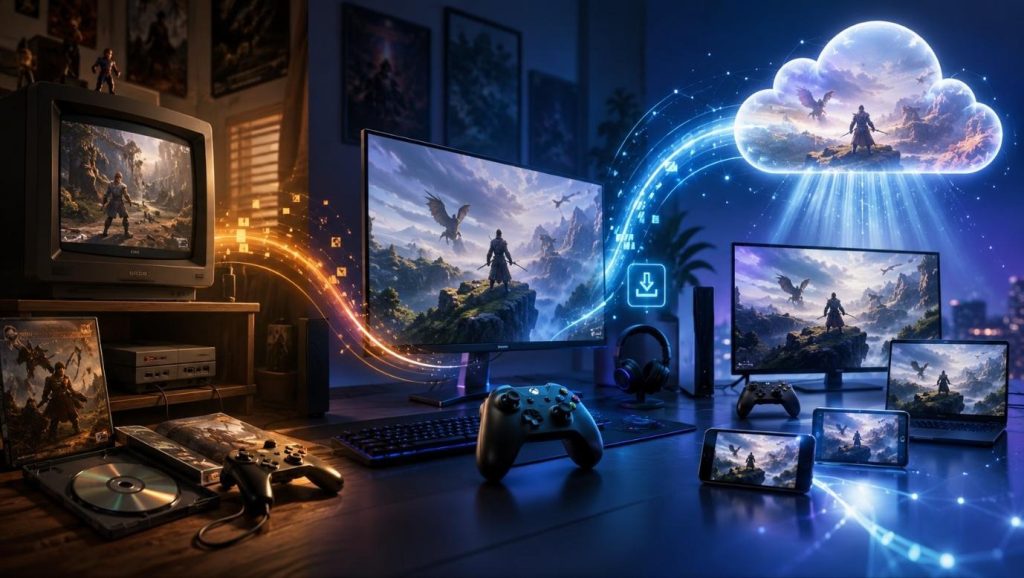
Anyone who entered the world of video games in the late nineties or early two thousand remembers a very specific ritual. Going to the shop, choosing the physical box, taking it home, installing the game for twenty minutes or simply inserting the disc and waiting for it to load. Accessing a game was a process full of friction, with several intermediate steps and plenty of waiting time. Today, that experience belongs to another era, and the data confirms it with a clarity that even those who follow the industry closely find surprising.
Digital distribution still coexists with debates about dependence on platforms and the need for a stable connection, although its evolution echoes other areas of online entertainment that have moved from more rigid formats to immediate experiences. Live casino is one of them, where titles such as monopoly big baller operate within an ecosystem based on streaming, servers and real-time access. In fact, digital distribution currently represents 95% of global video game sales. That figure alone sums up decades of transformation in a single line.
The long reign of digital downloads
The first big change was direct downloads. Steam made this popular starting in 2004, and soon the idea of buying a game from home and playing it within minutes changed the PC market. Consoles took a bit longer to catch up, but when they did, the impact was just as big. Stores like PlayStation Store, Xbox Marketplace, and Nintendo eShop made downloading games the norm for a whole generation of players.
Downloads have clear advantages that explain their massive adoption. The game is linked to an account, is available at any time without needing a disc, and digital prices have historically been more competitive during sales periods. On top of that, there is the possibility of preinstalling titles before launch, a feature that has turned midnight on release day into a global ritual for millions of players.
The cloud responds to a generation used to immediacy
Cloud gaming has promised for years to offer what downloads can’t, and in 2026, that promise is finally starting to feel real. The idea is simple but ambitious: instead of running on your device, the game runs on powerful remote servers and streams to your screen in real time. There’s no need to install anything, wait, or worry about your hardware.
Xbox Game Pass subscribers spent 45% more hours cloud gaming last year, and the service now works in 29 countries. NVIDIA has upgraded GeForce NOW to use RTX 5080-class GPUs, which can stream games in 4K at 240 frames per second on any device with a good connection. Sony also launched the PS Portal as a cloud gaming device in November 2025, letting people play over 2,000 PS5 games without needing a console at home.
What has changed in 2026 compared with previous attempts, such as Google Stadia’s failure, is that the infrastructure has matured to the point where latency is no longer the most common argument against the model. With a wired connection of 25 Mbps or more, the experience in most titles is indistinguishable from local hardware for the average player. For the most demanding competitive players, the perception is still different, but the gap has narrowed considerably.
The generation that combines instead of choosing
It might seem like these three models are separate choices, but that’s not how most people play today. The average mobile gamer is 36 years old and has used every format. They might buy a game on Steam and play it at home, then continue on their phone or tablet through the cloud when they’re out, and sometimes still buy physical copies if there’s a special edition they want to keep.
That combination of formats is not a sign of indecision, but the reflection of an industry that has learned to adapt to real user behaviour. The major cloud gaming services already offer the option to play from a user’s own digital library, blurring the distinction between what is downloaded and what is streamed. The cloud does not replace downloads; it expands them.
The major challenges remain unresolved
Even so, cloud gaming still has exposed weak points. Dependence on a stable connection remains its Achilles heel in areas with irregular infrastructure. Ownership of games is a debate that has yet to find a satisfying answer. If a service closes or changes its conditions, the library can disappear. Data consumption during long sessions can also become a real problem for users with monthly limits.
In the end, gaming habits have changed much the same way as those in other entertainment industries, moving from physical copies to digital access and from downloads to real-time streaming. Music streaming took about 10 years to surpass downloads, and gaming is heading the same way, though at its own pace and with its own challenges. The big difference is that the generation that saw these changes is still playing today.
