

When you apply for a sponsored visa to join a family member abroad, embassy officials need absolute certainty of the sponsor-applicant’s family ties. It’s usually verified using the primary visa documents. But in some scenarios, such documents aren’t considered authoritative enough by the immigration authorities. When this happens, they may request a DNA test report. That’s where the immigration DNA tests in Kolkata help many West Bengal-based applicants. This guide walks you through why these tests matter, who can use them, and how the process works from start to finish.
Common Reasons Why Embassies May Ask for a DNA Test
Immigration officers do not request a genetic report without good reason. You might be asked for one if any of the following apply to your case:
- You have had a visa application turned down before
- Your last name does not match your sponsor’s, even though you share a family bond
- Your passport photo does not look enough like you
- Some documents in your file are missing or incomplete
If any of these situations sound familiar, do not worry. A properly conducted DNA test gives you a straightforward way to remove doubt and move your case forward.
Types of Family Links Confirmed
You are not limited to proving a parent-child bond. Depending on who is sponsoring your visa, you may need to confirm one of these connections:
- Paternity – confirms the father-child genetic link
- Maternity – verifies the mother-child biological relationship
- Siblingship – validates the genetic link between alleged siblings
- Grandparentage – confirms the grandparent-grandchild biological connection
- Avuncular (Kinship) – authenticates the family link between an aunt/uncle and a niece or nephew
Whichever relationship your case involves, a lab expert will guide you on which test fits your visa category.
Understanding the DNA Testing Procedure
Getting tested is far simpler than most people expect. You will not need to worry about needles, long waits, or complicated paperwork if you follow these steps.
Step 1: Book Your Appointment – You start by scheduling a sample collection time that works for you. Most labs offer flexible slots so you do not have to disrupt your day.
Step 2: Give Your Sample – A trained professional collects your sample using a soft cotton swab, gently rubbed against the inside of your cheek. This method causes no pain and is safe for babies, adults, and elderly relatives alike.
Step 3: Cross-Border Coordination – If the sponsor and applicant are in different countries, the same lab coordinates the sample collection accordingly.
Step 4: Sample Analysis – Once your samples are sealed in tamper-proof packaging, they are sent to the testing facility. There, technicians examine specific genetic markers to check for a match between you and your sponsor.
Step 5: Report Delivery – A final report is prepared that clearly states whether a biological relationship exists. In most standard cases, this report is mailed directly to your home address.
Understanding the Chain of Custody Procedure
In certain cases, an embassy will insist on a supervised test known as a “chain of custody” procedure. Here is what makes it different from a standard test:
- An embassy-appointed official watches the entire sample collection
- The official checks your identification and confirms your photograph before testing begins
- Samples are sealed in front of the official to prevent any tampering
- The final report goes directly to the embassy, not to you
This process usually takes longer and costs more than a standard test. Because of this, it is smart to submit a DNA report along with your primary visa documents before you even apply. Doing so lowers your chances of facing this stricter, more expensive route later on.
What Affects the Cost of a DNA Test?
Pricing depends on a few factors, so it helps to know what to expect before you book:
1. Purpose of the test – A personal knowledge test is generally more affordable since it involves less paperwork. A test meant for a visa or court case costs more because of the added documentation and supervision required.
2. Number of people tested – Testing more family members naturally increases the total cost, since more samples must be processed.
3. Turnaround time – If you need your results quickly, an express option is usually available for an added fee.
Knowing these details in advance helps you plan your budget and avoid surprises when you book your appointment.
Common Reasons Families Choose to Get Tested
Sponsored immigration is one of the most common reasons people seek out testing, but it is far from the only one. You might also consider a test for:
- Settling personal doubts about a paternity or maternity connection
- Supporting a legal matter, such as an inheritance or property claim
- Meeting medical requirements, since Indian law requires proof of a family link before certain organ transplants can proceed
Whatever your reason, choosing a lab with proper accreditation ensures your results hold up wherever you need to present them.
Why Choose DDC Laboratories India?
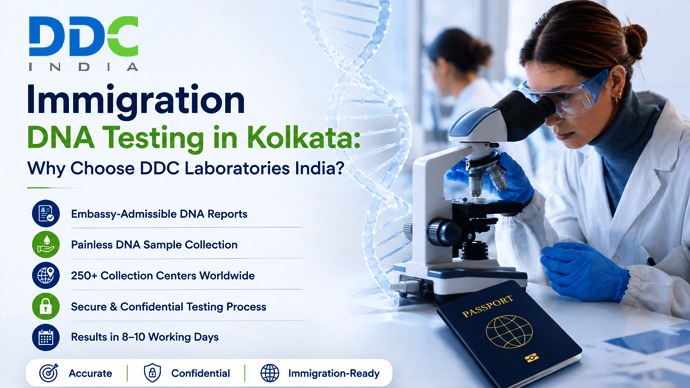
Not every lab is equipped to produce reports that embassies will accept. For your results to carry weight internationally, the lab conducting your test needs recognized accreditation. DDC Laboratories India holds accreditations from respected organizations, including NATA, IRCC, MOJ, and AABB. Because of these credentials, our reports are accepted by embassies in the United States, the United Kingdom, Canada, Australia, and several other countries.
Moreover, we have more than 250 sample collection centers across the globe, making it convenient for applicants to find a nearby testing facility. Besides, we also provide DNA tests for peace of mind, non-invasive prenatal paternity, cell line authentication, ancestry tests, and more.
Final Words
A sponsored visa application can feel stressful, especially when your paperwork alone cannot prove your family bond. That is exactly why so many West Bengal applicants turn to immigration DNA tests in Kolkata to strengthen their case and move their application forward with confidence. With the right lab by your side, you can complete the process smoothly, avoid unnecessary delays, and focus on what matters most: reuniting with your family.
Frequently Asked Questions
Q1. How to book an immigration DNA test online in India?
Call the experts at DDC Laboratories India and schedule an appointment for your DNA sample collection.
Q2. What documents are required for an immigration DNA test in India?
Two recent photos, a passport, government ID, and a consent form are required for an immigration DNA test in India.
Q3. How accurate are DNA tests used for immigration purposes?
DNA tests provide accuracy of 99.99%, which is enough for the report to be officially admissible in international embassies for sponsored immigration.
Q4. How long does an immigration DNA test take for visa purposes?
An immigration DNA test usually just requires a few minutes of a cheek swab. But if the test is under a chain of custody procedure, it’ll take longer than usual due to additional formalities.
Q5. What is the typical timeframe for receiving immigration DNA test results?
It usually takes around 4-5 business day to receive the final report of an immigration DNA test.
